

Area Of Triangle Linear Algebra
6.5 - Applications of Matrices and Determinants
 Area of a Triangle
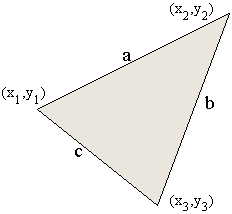
Consider a triangle with vertices at (x1,yane), (xii,y2), and (x3,yiii). If the triangle was a right triangle, it would exist pretty easy to compute the area of the triangle by finding i-one-half the product of the base and the acme.
However, when the triangle is not a right triangle, there are a couple of other ways that the area can be found.
Heron'south Formula
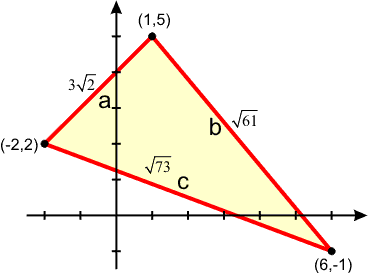 If you lot know the lengths of the three sides of the triangle, you tin use Heron'due south Formula to observe the expanse of the triangle.
In Heron's formula, south is the semi-perimeter (one-half the perimeter of the triangle).
s = 1/ii ( a + b + c )
Area = sqrt ( s ( s-a) ( s-b) ( south-c) )
Consider the triangle with vertices at (-2,2), (1,5), and (vi,i).
Using the distance formulas, nosotros can find that the lengths of the sides (arbitrarily assigning a, b, and c) are a = three sqrt(2), b = sqrt(61), and c = sqrt(73).
Using those values gives united states ...
s = 1/2 ( 3 sqrt(2) + sqrt(61) + sqrt(73) )
southward - a = 1/2 ( - 3 sqrt(two) + sqrt(61) + sqrt(73) )
s - b = ane/2 ( 3 sqrt(two) - sqrt(61) + sqrt(73) )
south - c = 1/ii ( three sqrt(2) + sqrt(61) - sqrt(73) )
s ( s - a ) ( s - b ) ( s - c ) = 1089 / 4
When you take the square root of that, yous get 33/two, so the area of that triangle is 16.5.
Problems with Heron'south Formula include
- Must know the lengths of the sides of the triangle. If you lot don't then you have to apply the altitude formula to discover the lengths of the sides of the triangle.
- You have to compute the semi-perimeter, and so chances are you will take fractions to work with.
- Lots of square roots are involved. For the lengths of the sides of the triangle and for the surface area of the triangle.
- It's not the easiest thing in the world to work with.
Geometric Technique
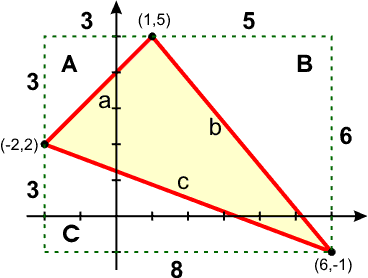 The triangle can be enclosed in a rectangle. The vertices of the triangle will intersect the rectangle in three places, forming three right triangles. These triangles are denoted A, B, and C in the motion picture.
The area of the triangle we desire volition be the area of the rectangle minus the areas of the 3 triangles.
The legs of the three triangles tin exist found by simple subtraction of coordinates so used to detect the area since the area of a triangle is half the base times the summit.
Area of triangle A = 3 ( iii ) / 2 = 9/2.
Surface area of triangle B = 5 ( 6 ) / 2 = 15.
Expanse of triangle C = eight ( 3 ) / two = 12.
The sum of the areas of the triangles is 9/2 + fifteen + 12 = 63 / 2 or 31.5.
The area of a rectangle is base times height, then the bounding rectangle has area = viii ( 6 ) = 48.
The area of the triangle in the eye is the deviation between the rectangle and the sum of the areas of the three outer triangles.
Area of triangle = 48 - 31.5 = sixteen.five.
Wow, that was much easier.
Determinants
It turns out that the area of a triangle can also exist found using determinants. The derivation of the formula is kind of long and nearly of you don't care to see it, and then it'south on a separate page.
What you exercise is form a 3×3 determinant where the kickoff cavalcade are the x's for all the points, the 2d column are the y's for all the points, and the concluding column is all ones.
| x | y | i | |
|---|---|---|---|
| point 1 | -two | 2 | 1 |
| point 2 | one | 5 | 1 |
| bespeak iii | six | -1 | 1 |
Evaluate that determinant. I'll expand on cavalcade 1.
| -2 | 2 | 1 | ||||||||||
| 1 | five | 1 | = | + (-two) | five | 1 | - 1 | ii | one | + 6 | 2 | 1 |
| 6 | -i | 1 | -1 | i | -1 | one | 5 | 1 |
= -2 ( 5 + one ) - one ( 2 + 1 ) + 6 ( two - 5 ) = -two ( 6 ) - 1 ( iii ) + 6 ( -3 ) = -12 - 3 - eighteen = -33.
Information technology is possible that you volition get a negative determinant, like we did hither. Don't worry about that. The sign is adamant by the order yous put the points in and tin can be easily inverse just past switching ii rows of the determinant. Surface area, on the other hand, tin't be negative, so if you get a negative, just drop the sign and make it positive. Finally, divide information technology by ii to find the area.
| -33 | = 33
33 / 2 = 16.5, which was the area.
Formula for the expanse of a triangle using determinants
| x1 | yane | 1 | ||
| Area = | ± one/2 | ten2 | yii | 1 |
| xiii | y3 | 1 |
The plus/minus in this instance is meant to take whichever sign is needed and then the answer is positive (non-negative). Do not say the area is both positive and negative.
Why not use absolute value, you ask? Well, call up how disruptive it would exist to take the absolute value of a determinant.
Test for Collinear Points
Go along with the thought of finding the area of a triangle. If the area of a triangle was equal to zero, then in that location would exist no triangle, the points would be collinear (on a line).
We can use that fact to develop a test for collinear points.
If the area of a triangle is nada, the points are collinear.
Nosotros tin can drop the plus/minus and the one-half from the forepart of the determinant, considering the area will be nil but if the determinant is zilch.
Three points are collinear if and only if the determinant institute by placing the 10-coordinates in the start column, the y-coordinates in the second column, and one'south in the third cavalcade is equal to zero.
| x1 | y1 | 1 | ||
| Does | x2 | y2 | one | equal 0? |
| xthree | y3 | 1 |
Y'all are not setting the determinant equal to nix, you lot are testing to see if the determinant is zero.
Equation of a Line
Iii points are collinear if and merely if that determinant is zero.
You lot can force iii points to be collinear past setting the determinant equal to zero.
Discover this time, that the actual variables x and y are in the determinant. That is considering you take two points on a line given, and the point (x,y) is a generic point on the line.
When you expand this, I strongly recommend that you expand forth the starting time row. That style, your multiplications to find the determinants won't involve x or y.
| x | y | 1 | ||
| x1 | yone | 1 | = | 0 |
| x2 | y2 | ane |
Cramer'due south Rule
The derivation of Cramer'due south Rule can exist found on another page. Hither are the results.
Solve the system of linear equations
3x + 5y = 12 2x - 4y = nine
Let D be the determinant of the coefficient matrix.
| x | y | ||
|---|---|---|---|
| D = | iii | 5 | = - 22 |
| 2 | -4 |
Let Dx be the determinant of the coefficient matrix where the x column has been replaced past the constants from the correct hand side.
| rhs | y | ||
|---|---|---|---|
| Dten = | 12 | 5 | = - 93 |
| nine | -four |
Let Dy exist the determinant of the coefficient matrix where the y column has been replaced by the constants from the right hand side.
| x | rhs | ||
|---|---|---|---|
| Dy = | three | 12 | = 3 |
| 2 | ix |
As long equally D, the determinant of the coefficient matrix, is not 0, then 10 = Dx / D and y = Dy / D.
In this case, D = -22, so Cramer's Rule will work and
ten = D10 / D = -93 / -22 = 93/22
y = Dy / D = 3 / -22 = - 3/22
Cramer's rule is named after Gabriel Cramer who lived from 1704 - 1752. He is not the 1 who developed the technique originally, however, as the Chinese were known to accept used the method earlier him.
Extending Cramer'southward Rule to Larger Systems
Cramer'due south Rule can be extended to larger systems in the same style. Simply replace each column in the coefficient matrix by the right hand side, and then divide that determinant by the determinant of the coefficient matrix.
For a three×three arrangement, then let Dz be the determinant of the coefficient matrix where the z column has been replaced by the constants from the correct hand side.
Benefits of Cramer's Rule
- Determinants can exist found on a calculator for large systems
- If you demand merely i variable, you can notice it with Cramer'south Rule, whereas with the other techniques y'all would take to find all of the variables.
Problems with Cramer'due south Dominion
- Takes a long time to re-enter each matrix into the calculator to detect the determinant. Best suited for a calculator or computer program.
- Requires a foursquare system.
- Doesn't e'er work. If the determinant of the coefficient matrix is zero, the technique fails and it is either no solution or many solutions.
- If D=0 and Dx=0 and Dy=0 then there are many solutions. You won't be able to tell what the solutions are from Cramer's Rule, only there are many solutions. This is the dependent case.
- If D=0, only at least i of the other determinants is not zero, and so in that location is no solution. This is the inconsistent case.
Cryptography
Cryptography involves encrypting information and so that a third party can non intercept and read the information.
In the early days of satellite television, the video signals weren't encrypted and anyone with a satellite dish could watch any was being shown. Well, this didn't piece of work because all of the networks using satellites didn't want the satellite dish owners to be able to receive their satellite feed for no price while cable subscribers had to pay for the channel, they were losing coin. And so, they started encrypting the video signal with a arrangement chosen Videocipher (subsequently replaced by Videocipher 2).
What the Videocipher encryption system did was to convert the betoken into digital form, encrypt it, and send the data over the satellite. If the satellite dish owner had a Videocipher box, and paid for the channel, so the box would descramble (unencrypt) the bespeak and return it to its original, useful form.
This was done by using a key that was invertible. Information technology was very of import that they key exist invertible, or there would be no way to return the encrypted data to its original form.
The aforementioned thing tin can be done using matrices.
Encryption Process
- Catechumen the text of the message into a stream of numerical values.
- Identify the information into a matrix.
- Multiply the data by the encoding matrix.
- Convert the matrix into a stream of numerical values that contains the encrypted message.
Case
Consider the message "Red Rum"
A message is converted into numeric course co-ordinate to some scheme. The easiest scheme is to let space=0, A=1, B=2, ..., Y=25, and Z=26. For example, the message "Red Rum" would become 18, 5, iv, 0, 18, 21, 13.
This data was placed into matrix grade. The size of the matrix depends on the size of the encryption central. Let'south say that our encryption matrix (encoding matrix) is a 2x2 matrix. Since I have seven pieces of data, I would identify that into a 4x2 matrix and fill the last spot with a space to make the matrix complete. Let'south call the original, unencrypted data matrix A.
| 18 | 5 | |||
| A = | iv | 0 | ||
| 18 | 21 | |||
| 13 | 0 |
There is an invertible matrix which is chosen the encryption matrix or the encoding matrix. We'll call it matrix B. Since this matrix needs to be invertible, information technology must exist square.
This could actually be anything, it's up to the person encrypting the matrix. I'll employ this matrix.
| B = | 4 | -2 | ||
| -i | three |
The unencrypted data is then multiplied past our encoding matrix. The result of this multiplication is the matrix containing the encrypted information. We'll telephone call it matrix X.
| 67 | -21 | |||
| X = A B = | 16 | -8 | ||
| 51 | 27 | |||
| 52 | -26 |
The message that you would pass on to the other person is the the stream of numbers 67, -21, sixteen, -8, 51, 27, 52, -26.
Decryption Procedure
- Place the encrypted stream of numbers that represents an encrypted message into a matrix.
- Multiply by the decoding matrix. The decoding matrix is the inverse of the encoding matrix.
- Convert the matrix into a stream of numbers.
- Conver the numbers into the text of the original message.
Example
The message you need to decipher is in the encrypted information stream 67, -21, 16, -viii, 51, 27, 52, -26.
The encryption matrix is not transmitted. It is known past the receiving party so that they can decrypt the message. Other times, the inverse is known by the receiving party. The encryption matrix tin not be sent with the data, otherwise anyone could grab the data and decode the information. Likewise, by non having the decoding matrix, someone intercepting the bulletin doesn't know what size of matrix to use.
The receiving finish gets the encrypted message and places it into matrix class.
| 67 | -21 | |||
| 10 = | sixteen | -8 | ||
| 51 | 27 | |||
| 52 | -26 |
The receiver must calculate the inverse of the encryption matrix. This would be the decryption matrix or the decoding matrix.
| B-1 = | 0.three | 0.2 | ||
| 0.one | 0.iv |
The receiver then multiplies the encrypted data by the inverse of the encryption matrix. The outcome is the original unencrypted matrix.
| eighteen | five | |||
| A = X B-one = | 4 | 0 | ||
| 18 | 21 | |||
| xiii | 0 |
The receiver then takes the matrix and breaks it apart into values eighteen, v, iv, 0, 18, 21, 13, 0 and converts each of those into a character according to the numbering scheme. 18=R, five=E, 4=D, 0=infinite, eighteen=R, 21=U, 13=M, 0=space.
Abaft spaces volition be discarded and the bulletin is received every bit intended: "Red RUM"

Area Of Triangle Linear Algebra,
Source: https://people.richland.edu/james/lecture/m116/matrices/applications.html
Posted by: handleyhadful.blogspot.com
0 Response to "Area Of Triangle Linear Algebra"
Post a Comment