

Bohr Model Diagrams Worksheet Answers
Bohr Diagrams of Atoms and Ions
- Page ID
- 37159
Objectives
- Retrieve the stability associated with an atom that has a completely-filled valence shell
- Construct an atom according to the Bohr model
Key Terms
- Octet rule: A rule stating that atoms lose, gain, or share electrons in order to have a full valence shell of 8 electrons. (Hydrogen is excluded considering it can hold a maximum of 2 electrons in its valence shell. )
- Electron shell: The commonage states of all electrons in an cantlet having the same principal quantum number (visualized as an orbit in which the electrons move).
Electron Shells
Niels Bohr proposed an early model of the atom as a central nucleus containing protons and neutrons being orbited by electrons in shells. As previously discussed, there is a connection between the number of protons in an element, the atomic number that distinguishes i element from another, and the number of electrons it has. In all electrically-neutral atoms, the number of electrons is the aforementioned as the number of protons. Each chemical element, when electrically neutral, has a number of electrons equal to its diminutive number.
An early model of the atom was developed in 1913 past Danish scientist Niels Bohr (1885–1962). The Bohr model shows the atom equally a central nucleus containing protons and neutrons with the electrons in round orbitals at specific distances from the nucleus (Figure \(\PageIndex{1}\)). These orbits form electron shells or energy levels, which are a manner of visualizing the number of electrons in the various shells. These energy levels are designated past a number and the symbol "n." For example, the 1n shell represents the showtime energy level located closest to the nucleus.
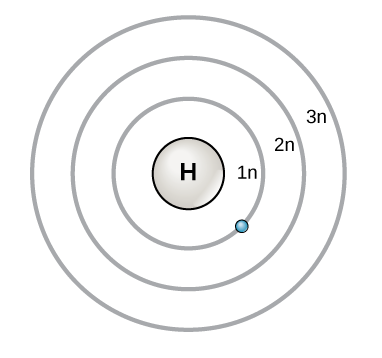
An electron usually exists in the lowest energy beat available, which is the 1 closest to the nucleus. Free energy from a photon of light tin can crash-land it upwardly to a higher energy shell, merely this situation is unstable and the electron chop-chop decays back to the basis state.
Bohr Diagrams
Bohr diagrams show electrons orbiting the nucleus of an atom somewhat like planets orbit effectually the sunday. In the Bohr model, electrons are pictured as traveling in circles at different shells, depending on which chemical element you have. Figure \(\PageIndex{2}\) contrast the Bohr diagrams for lithium, fluorine and aluminum atoms. The trounce closest to the nucleus is called the M shell, side by side is the L vanquish, next is the M crush.
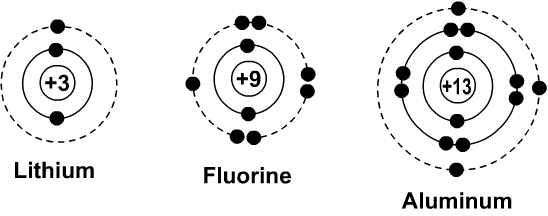
Each shell can merely hold certain number of electrons. K shell can have ii, L can have eight , M can have xviii electrons and then on.
- Lithium has three electrons:
- ii go to M shell and
- the remaining one goes to the L trounce.
- Its electronic configuration is K(2), L(1)
- Fluorine has nine electrons:
- ii become to One thousand shell and
- the remaining 7 become to the L shell.
- Its electronic configuration is 1000(2), 50(7). Note that L tin have 8 electrons.
- Aluminum has thirteen electrons:
- ii get to the Yard shell,
- eight go to the 50 shell, and
- remaining three get to the Thousand shell.
- Its electronic configuration is Thousand(2), L(8), M(3). Note that the Chiliad beat out can take 18 electrons.
Orbitals in the Bohr model
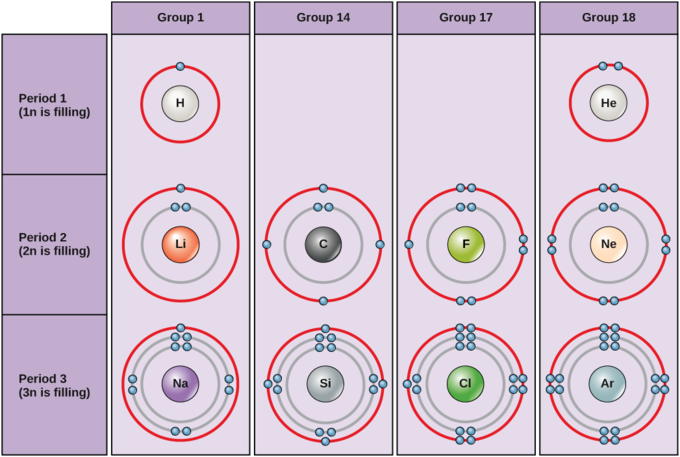
Electrons make full orbit shells in a consistent society. Under standard weather, atoms fill the inner shells (closer to the nucleus) start, often resulting in a variable number of electrons in the outermost shell. The innermost shell has a maximum of two electrons, but the next two electron shells can each take a maximum of eight electrons. This is known as the octet rule which states that, with the exception of the innermost trounce, atoms are more stable energetically when they have eight electrons in their valence vanquish, the outermost electron shell. Examples of some neutral atoms and their electron configurations are shown in Effigy \(\PageIndex{3}\). As shown, helium has a complete outer electron beat out, with 2 electrons filling its first and only beat out. Similarly, neon has a complete outer 2n beat out containing 8 electrons. In contrast, chlorine and sodium accept seven and one electrons in their outer shells, respectively. Theoretically, they would exist more energetically stable if they followed the octet dominion and had eight.
Bohr diagrams
Bohr diagrams indicate how many electrons fill up each principal shell. Group eighteen elements (helium, neon, and argon are shown) have a full outer, or valence, crush. A full valence shell is the most stable electron configuration. Elements in other groups have partially-filled valence shells and gain or lose electrons to attain a stable electron configuration.
An cantlet may proceeds or lose electrons to achieve a full valence vanquish, the nearly stable electron configuration. The periodic tabular array is arranged in columns and rows based on the number of electrons and where these electrons are located, providing a tool to empathize how electrons are distributed in the outer vanquish of an atom. Every bit shown in , the grouping 18 atoms helium (He), neon (Ne), and argon (Ar) all have filled outer electron shells, making it unnecessary for them to proceeds or lose electrons to attain stability; they are highly stable as single atoms. Their non-reactivity has resulted in their being named the inert gases (or noble gases). In comparison, the group one elements, including hydrogen (H), lithium (Li), and sodium (Na), all accept 1 electron in their outermost shells. This ways that they can achieve a stable configuration and a filled outer vanquish by donating or losing an electron. As a upshot of losing a negatively-charged electron, they get positively-charged ions. When an atom loses an electron to go a positively-charged ion, this is indicated by a plus sign after the chemical element symbol; for instance, Na+. Group 17 elements, including fluorine and chlorine, have vii electrons in their outermost shells; they tend to fill this crush by gaining an electron from other atoms, making them negatively-charged ions. When an atom gains an electron to become a negatively-charged ion this is indicated by a minus sign after the element symbol; for example, \(F^-\). Thus, the columns of the periodic tabular array stand for the potential shared country of these elements' outer electron shells that is responsible for their similar chemical characteristics.
Lewis Symbols
Lewis Symbols are simplified Bohr diagrams which only display electrons in the outermost energy level.
Summary
- In the Bohr model of the atom, the nucleus contains the bulk of the mass of the atom in its protons and neutrons.
- Orbiting the positively-charged core are the negatively charged electrons, which contribute piffling in terms of mass, only are electrically equivalent to the protons in the nucleus.
- In most cases, electrons fill the lower-energy orbitals first, followed by the next higher energy orbital until it is full, and so on until all electrons have been placed.
- Atoms tend to be most stable with a total outer vanquish (one which, after the outset, contains eight electrons), leading to what is commonly called the "octet rule".
- The properties of an element are determined past its outermost electrons, or those in the highest free energy orbital.
- Atoms that do not accept full outer shells will tend to proceeds or lose electrons, resulting in a full outer shell and, therefore, stability.
Contributors and Attributions
Dizzying (www.boundless.com)
- Manish Bhardwaj

Bohr Model Diagrams Worksheet Answers,
Source: https://chem.libretexts.org/Bookshelves/Physical_and_Theoretical_Chemistry_Textbook_Maps/Supplemental_Modules_%28Physical_and_Theoretical_Chemistry%29/Electronic_Structure_of_Atoms_and_Molecules/Bohr_Diagrams_of_Atoms_and_Ions
Posted by: handleyhadful.blogspot.com
0 Response to "Bohr Model Diagrams Worksheet Answers"
Post a Comment